EN
EN

Choosing the right circuit breaker matters for safety and uptime, whether you work on a home panel, a commercial installation, or an industrial power system. This guide explains the practical differences between AC and DC breakers, how each type works, and where they belong. AC breakers are built for alternating current and benefit from the waveform’s natural zero-crossings. DC breakers must handle steady current and use specialized arc-control features. We cover operation, design trade-offs, and how those differences affect the best choice for specific applications.
Research supports grouping breakers by voltage and current type to guide correct selection in power systems.
AC vs. DC Circuit Breaker Classification & Applications
A review of circuit breaker types used in power transmission and distribution. The paper shows classifying breakers by voltage rating — and by AC or DC application — is practical. It notes DC solutions (mechanical, solid-state, hybrid) are common in DC systems including HVDC, while AC breakers are produced for both high- and low-voltage networks.
Applications of various types of circuit breakers in electrical power systems: a review, PI Obi, 2021
What Is an AC Circuit Breaker and How Does It Work?
An AC circuit breaker protects a circuit by stopping alternating current when it detects a fault like an overload or a short. Most AC breakers use thermal and/or electromagnetic trip elements that react to excess current and open the circuit. Because the AC waveform crosses zero twice each cycle, breakers can use that moment to extinguish arcs more easily, which simplifies arc control and helps protect wiring and equipment.
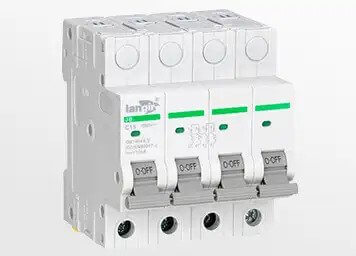 Get a quote for custom DC circuit breakers from Langir
What Are the Typical Applications of AC Circuit Breakers?
- Residential Settings: Protect wiring, outlets, and household appliances from overloads and short circuits.
- Commercial Buildings: Defend panels, lighting circuits, and HVAC equipment in offices and retail spaces.
- Industrial Facilities: Protect motors, control circuits, and production lines from electrical faults.
These common uses show why AC breakers are the default choice where alternating current is the system standard.
How Does Zero-Crossing Arc Extinguishing Function in AC Breakers?
Zero-crossing arc extinguishing takes advantage of the AC waveform dropping to zero volts twice per cycle. By interrupting near those points, the breaker reduces arc energy and makes it easier to put the arc out quickly. That natural interruption window lowers stress on contacts and insulating materials, improving breaker longevity and safety in AC installations.
What Is a DC Circuit Breaker and What Makes It Unique?
A DC circuit breaker is built to interrupt steady direct current. Because DC doesn’t cross zero, arcs are harder to extinguish and can persist. DC breakers therefore use extra measures — like magnetic blowout coils, arc chutes, or electronic switching — to stretch, cool, and break the arc reliably. These features let DC breakers handle continuous current safely in solar, EV, and industrial systems.
What Are Common DC Circuit Breaker Applications Including Langir’s JB Series?
- Solar Power Systems: Protect PV strings, combiner boxes, and inverter inputs from overcurrent.
- Electric Vehicle Charging Stations: Provide safe disconnection and fault protection during charging.
- Industrial Equipment: Safeguard DC-powered drives, control systems, and specialty machinery.
Langir Electric’s JB Series is engineered for these DC environments, delivering reliable interruption and robust arc control for demanding applications.
How Do Magnetic Blowout Coils and Arc Chutes Extinguish Arcs in DC Breakers?
Magnetic blowout coils create a magnetic field that pulls and stretches the arc, increasing its length and lowering its current density until it can be quenched. Arc chutes cool and split the arc into smaller segments inside a controlled chamber so it loses strength quickly. Used together, these methods let DC breakers interrupt faults that would otherwise sustain dangerous arcs.
What Are the Core Design Differences Between AC and DC Circuit Breakers?
Design differences reflect how each current type behaves. AC breakers rely on waveform zero-crossings to help extinguish arcs; DC breakers need dedicated arc-control hardware and often stronger insulation. Those differences affect contact design, spacing, insulation levels, and overall mechanical layout.
How Do Contact Spacing and Insulation Vary Between AC and DC Breakers?
AC breakers can use tighter contact spacing because the waveform gives natural interruption points. DC breakers need wider gaps and more insulation to stop sustained arcs and prevent flashovers. As voltage and current rise, designers increase creepage distances and dielectric strength to keep installations safe.
Why Is DC Breaker Design More Complex Than AC Breakers?
DC breaker design must solve persistent-arc problems that AC breakers usually avoid. That pushes engineers to optimize contact materials, spacing, magnetic blowout geometry, arc-chute layout, and insulation. The result is a more intricate design process aimed at safe, repeatable interruption under continuous current.
Recent studies emphasize the detailed energy-absorption and arc-management strategies required across breaker designs.
AC vs. DC Circuit Breaker Design & Energy Absorption
The paper discusses how different breaker designs handle the energy released during fault interruption. While AC mechanical breakers protect AC circuits effectively, alternative designs and strategies are important for absorbing and managing released energy in other systems.
DC circuit breaker evolution, design, and analysis, M Moradian, 2023
Why Are DC Arcs Harder to Interrupt Than AC Arcs?
DC arcs are harder to interrupt because the current is continuous and lacks the natural zero points of AC. Without those brief zeros, an arc can persist until it’s physically lengthened, cooled, or suppressed by magnetic or mechanical means. That reality drives the special features you see in DC breakers.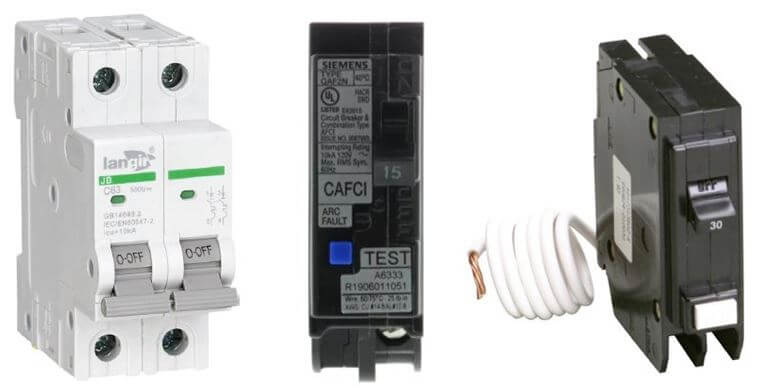
Get a quote for custom DC circuit breakers from Langir
The greater difficulty of interrupting DC compared with AC is well documented in arc-extinction research.
DC Arc Interruption Challenges vs. AC Current-Zero
DC current is harder to interrupt because AC has a current-zero each cycle. For DC voltages (below 500V in this study), magnetic blow-out is commonly used to extinguish arcs.
Fundamental characteristics of arc extinction by magnetic blow-out at DC voltages (< 500V) II, 2015
What Challenges Does Continuous DC Current Pose for Arc Extinguishing?
- Sustained Arcing: Arcs can burn as long as current flows, so breakers need stronger suppression.
- Higher Energy Levels: DC faults can carry more steady energy, increasing damage risk if not cleared quickly.
- Increased Heat Generation: Longer arcs produce more heat, stressing contacts and insulation.
These factors make robust arc control and reliable interruption essential in DC systems.
How Do Arc Suppression Techniques Differ for AC and DC Systems?
AC systems rely heavily on the waveform’s zero crossings for arc suppression, while DC systems use mechanical and magnetic measures — such as blowout coils, arc chutes, and segmented contacts — or electronic breakers that switch rapidly. Choosing the right technique depends on voltage, current, and the application’s safety requirements.
Can AC and DC Circuit Breakers Be Used Interchangeably?
Although both types protect circuits, AC and DC breakers are not interchangeable in most cases. Each is engineered for the electrical behavior it will face; using the wrong type risks ineffective arc control, insulation failure, or unsafe operation.
What Are the Safety Risks of Using AC Breakers in DC Circuits?
- Inadequate Arc Management: AC breakers often can’t extinguish DC arcs, leading to prolonged arcing and damage.
- Insulation Failure: AC-rated insulation may not tolerate higher or sustained DC voltages.
- Increased Risk of Fire: Persistent arcing and overheating raise the chance of fires.
Those risks show why selecting a breaker rated for the circuit’s current type and voltage is critical.
How Does Interchangeability Affect Reliability and Equipment Protection?
Swapping AC and DC breakers can reduce reliability and increase maintenance or replacement costs. An AC breaker used on DC may fail prematurely or allow unsafe arcs; a DC breaker used on AC can be overbuilt and more expensive than necessary. Match the breaker to application needs to protect equipment and budgets.
How Do Application Differences Influence AC vs DC Circuit Breaker Selection?
Application needs — like expected currents, voltage, and the source type — drive breaker selection. Understand the operating environment and fault scenarios to pick the right technology and rating.
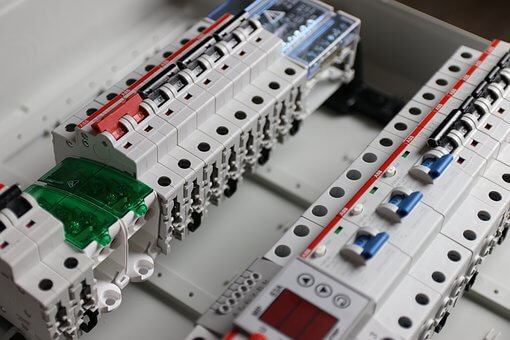
Get a quote for custom DC circuit breakers from Langir
Which Circuit Breakers Are Preferred for Residential and Commercial AC Systems?
For homes and many commercial sites, miniature circuit breakers (MCBs) are common because they combine compact size with reliable protection against overloads and short circuits. For added safety, commercial systems may use MCBs alongside residual current devices (RCDs) to guard against ground faults.
Why Are DC Breakers Essential for Solar PV, EV Charging, and Industrial Systems?
Solar PV, EV charging, and many industrial systems generate or use continuous DC. DC breakers are designed to interrupt steady currents safely and to manage the higher insulation and arc-control requirements those systems need. That makes them indispensable for protecting equipment and personnel in DC environments.
Different breaker types play distinct roles across systems. Base your choice on current type, voltage rating, and environmental or safety requirements. For tailored advice or to discuss specific project needs, please contact us.
AC vs DC Circuit Breakers | FAQs
What are the main differences in safety features between AC and DC circuit breakers?
AC breakers often include ground-fault protection and standard overload trips suited to alternating current. DC breakers focus on preventing and extinguishing sustained arcs, using features like magnetic blowout coils, arc chutes, or solid-state interruption. Each approach addresses the distinct hazards of the current type to keep systems safe.
How do environmental factors influence the choice between AC and DC circuit breakers?
Temperature, humidity, dust, and corrosive atmospheres affect breaker performance. AC breakers are typically designed for a broad range of conditions, while DC breakers may need extra enclosures, coatings, or IP-rated housings to protect arc-control components and ensure long-term reliability in harsh environments.
What maintenance practices are recommended for AC and DC circuit breakers?
Regular inspections and preventive maintenance extend life and reliability. For AC breakers, check trip mechanisms, contacts, and signs of wear. For DC breakers, add checks of arc-control parts, contact spacing, and insulation condition. A scheduled maintenance plan helps catch wear before it leads to failures.
Can circuit breakers be retrofitted for different applications?
Some breakers can be adapted, but converting between AC and DC use is rarely advisable. Retrofitting often requires significant changes to insulation, contact geometry, and arc-control systems. In most cases it’s safer and more cost-effective to install a breaker designed for the specific application.
What role do circuit breakers play in renewable energy systems?
Breakers protect inverters, string connections, and downstream equipment from overloads and short circuits. In solar systems, DC breakers are especially important at the PV side to manage continuous current and arc risk, while AC breakers protect inverter outputs and building circuits.
How do voltage ratings affect the selection of circuit breakers?
Voltage rating determines the maximum voltage the breaker can safely interrupt. AC breakers commonly match household and commercial voltages (e.g., 120V, 240V), while DC breakers may require higher ratings for PV, battery, or HVDC systems. Choosing the correct voltage rating prevents insulation breakdown and ensures safe interruption.
What advancements are being made in circuit breaker technology?
Innovations include smart breakers with remote monitoring and control, improved contact materials, and hybrid designs that combine mechanical and solid-state interruption for faster, cleaner breaks. Advances in digital trip units and arc-suppression methods are improving safety and diagnostics across both AC and DC products.
Conclusion
Knowing the differences between AC and DC circuit breakers helps you pick the right protection for any system. Each type has strengths tailored to its current form — AC breakers take advantage of waveform zeros, while DC breakers include dedicated arc-control and insulation features. Choose breakers that match your voltage, current type, and operating environment to maximize safety and reliability. For product recommendations or technical support, please contact us.
 EN
EN  FR
FR  PL
PL  PT
PT  ES
ES  JA
JA  RU
RU  AR
AR  IT
IT  NL
NL  TR
TR  KO
KO  DE
DE