EN
EN

Push button switches are the nerve centers of modern vehicles, translating driver commands into immediate electrical responses. From igniting the engine to adjusting cabin lighting, these compact controls ensure seamless operation of essential functions. In this guide, you’ll uncover how automotive buttons drive engine start systems, manage lighting, control windows, and enhance infotainment and safety features. We’ll delve into the primary applications, typical switch types, customization options, key specifications, emerging trends, and common challenges faced by drivers and OEMs—and how Langir’s bulk supply and custom manufacturing services address them. Ready to explore the realm of car push button switches? Let’s dive into each core application.
Main Automotive Applications of Push Button Switches
Push button switches act as direct interfaces between driver commands and a vehicle’s electrical systems, instantly opening or closing circuits to activate specific functions. They simplify engine ignition, control lighting, operate power windows, adjust infotainment/climate settings, and activate safety systems—enhancing both convenience and user experience.
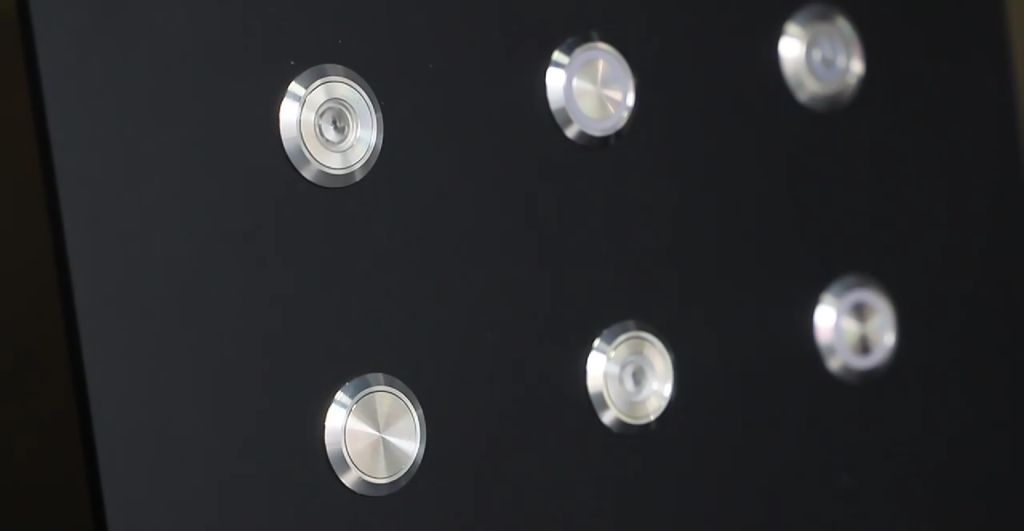
Get a quote for custom automotive push button switches from Langir
Key Automotive Applications of Push Button Switches
In modern vehicles, push button switches control various functions, including engine ignition, lighting, and window operation. These switches provide a direct interface between driver commands and the vehicle’s electrical systems, enhancing convenience and user experience.
RS, Comprehensive Guide to Push Button Switches (2024)
This source underscores the diverse applications of push button switches in modern vehicles, supporting the article’s claims about their role in various vehicle functions.
When you press a button, a momentary or latching mechanism completes the circuit, sending power to the desired component. Below are the five most common automotive applications:
- Engine Start/Stop – Initiates ignition with keyless convenience.
- Lighting Control – Toggles headlights, fog lamps, and interior ambient lighting.
- Window & Door Operation – Raises or lowers power windows and locks doors.
- Infotainment & Climate – Adjusts audio, navigation, and HVAC settings.
- Safety & Warning – Activates horn, hazard lights, and emergency systems.
These core functions set the stage for a detailed exploration of each application’s role, starting with how push button switches command your engine.
Engine Start Functions: How Push Button Switches Take Control
Engine start buttons replace traditional keys by sending a momentary signal to the starter relay and ECU when pressed. A normally open contact closes only while you hold the button, allowing high-current ignition power to flow briefly.
- Signal Flow: Button press → Starter relay → Crank motor engagement
- Benefit: Faster, keyless ignition with built-in anti-theft integration
- Example: Modern vehicles often pair push start switches with smart key fobs
This mechanism not only simplifies ignition but also links directly to vehicle security features. Understanding that control logic leads us to examine lighting systems next.
Lighting Systems: The Role of Push Button Switches
Push button lighting controls let drivers toggle headlights, fog lights, and interior lamps with one fingertip. A latching switch holds state until pressed again, while illuminated variants provide visual feedback on active circuits.
- Headlight Activation – Latching switch closes circuit until next touch
- Fog Light Override – Momentary style for temporary illumination
- Dashboard Illumination – Backlit buttons adapt intensity with ambient sensors
By closing and maintaining circuit states, these switches enhance visibility and ease of use—paving the way to power window and door controls.
Power Window and Door Controls: Push Button Switches in Action
Power window and door switch modules integrate multiple momentary push buttons that send brief pulses to window motors or central locking actuators. Each press completes a circuit only while depressed, ensuring precise up/down or lock/unlock commands.
- Window Lift/Lower – SPST momentary contacts control motor direction
- Child Lock Buttons – Latching function to disable rear switches
- Central Locking – Illuminated feedback confirms locked status
This precise on-demand activation model carries over to how dashboard switches manage infotainment and climate systems.
Infotainment and Climate Control: Push Button Switch Applications
Dashboard push buttons send digital or analog signals to multimedia and HVAC controllers, merging tactile feedback with software-driven menus. Short presses and long presses can select sources, adjust volume, or toggle fan speeds.
- Audio Source Selection – Stepped momentary inputs in infotainment units
- Temperature Adjustment – Incremental latching switches for climate zones
- Mode Toggle – Multi-function buttons that cycle through airflow patterns
By bridging mechanical actuation with electronic modules, these switches create intuitive cabin interfaces—leading us to their critical role in safety systems.
Enhancing Automotive Safety Systems with Push Button Switches
Safety-related push buttons include hazard lights, horn activation, and emergency service calls. A dedicated red latching switch for hazards keeps warning lights active until manually disengaged, while a momentary horn switch provides immediate auditory alerts.
- Hazard Light Activation – Latching contact until driver resets
- Horn Button – Momentary circuit for short horn blasts
- SOS/E-Call – Illuminated momentary switch to contact emergency services
With safety functions managed by reliable switch designs, we next explore the variety of switch types that make these applications possible.
Types of Push Button Switches in Automotive Applications
Automotive push button switches come in several mechanical styles—momentary, latching, illuminated, and ruggedized waterproof variants—to meet diverse vehicle environments and user experiences. Each type balances actuation feel with circuit requirements.
Below is a comparison of the four primary switch types:
This table outlines each type’s role and helps you choose the right variant for your automotive application. Next, we’ll define momentary and latching switches in more detail.
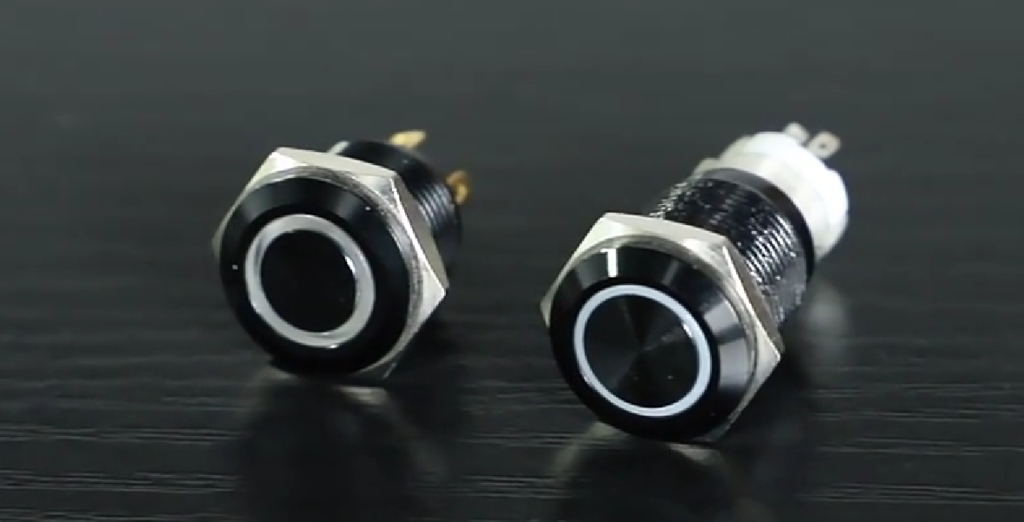
Get a quote for custom automotive push button switches from Langir
Momentary Push Button Switches: Applications in Vehicles
A momentary push button switch closes its contacts only while you press it, then springs back open when released. This on-demand action makes it ideal for functions requiring brief activation:
- Horn button – short, sharp alerts
- Push-to-talk microphone controls
- Temporary lighting overrides
Momentary switches deliver instantaneous control, preparing us to explore the stable engagement of latching switches.
Latching Push Button Switches: How They Work in Automotive Settings
A latching switch toggles between on and off states with each press, mechanically locking the contact until the next actuation. Typical uses include:
- Headlight on/off control
- Hazard warning activation
- Interior courtesy lamp lock
By maintaining circuit state without continuous pressure, latching switches streamline sustained functions before we examine illuminated switch benefits.
Illuminated Push Button Switches: Benefits in Cars
Illuminated switches integrate LEDs into the actuator, providing visual cues in low-light conditions and reinforcing safe operation. Key advantages include:
- Improved visibility at night
- Clear status feedback for active circuits
- Customizable color options for brand alignment
These backlit buttons enhance user experience and guide drivers toward the importance of rugged sealing in harsh environments.
Importance of Waterproof and Dustproof Push Button Switches for Vehicles
Waterproof and dustproof switches (IP65–IP67) ensure reliable operation under extreme conditions by preventing contaminants from compromising contacts. They excel in:
- Off-road vehicles exposed to mud and debris
- Marine and convertible top controls
- Under-hood engine bay functions
Sealed switch designs dramatically reduce maintenance issues, leading us into how you can tailor switches to your exact specifications.
Customizing Push Button Switches for Automotive Applications
Custom automotive push button switches let OEMs differentiate their dashboards, meet unique environmental challenges, and maintain brand consistency. Langir’s bulk and customization capabilities cover design, illumination, color, icons, and electrical specs.
Below are the primary customization options available:
- Actuator Style & Color – Flat, domed, or custom-molded buttons in any Pantone shade.
- LED Illumination – Single-color or RGB backlighting and programmable flash patterns.
- Iconography & Engraving – Custom symbols, logos, or alphanumeric labels.
- Electrical Ratings – Tailored voltage/current specs to match BMS, CAN-bus, or relay systems.
- Sealing & Materials – IP-rated housings in stainless steel, brass, or plastic for harsh environments.
These options support precise application needs. The customization process itself follows a structured workflow:
With customization covered, let’s examine how those design choices translate into core product specifications.
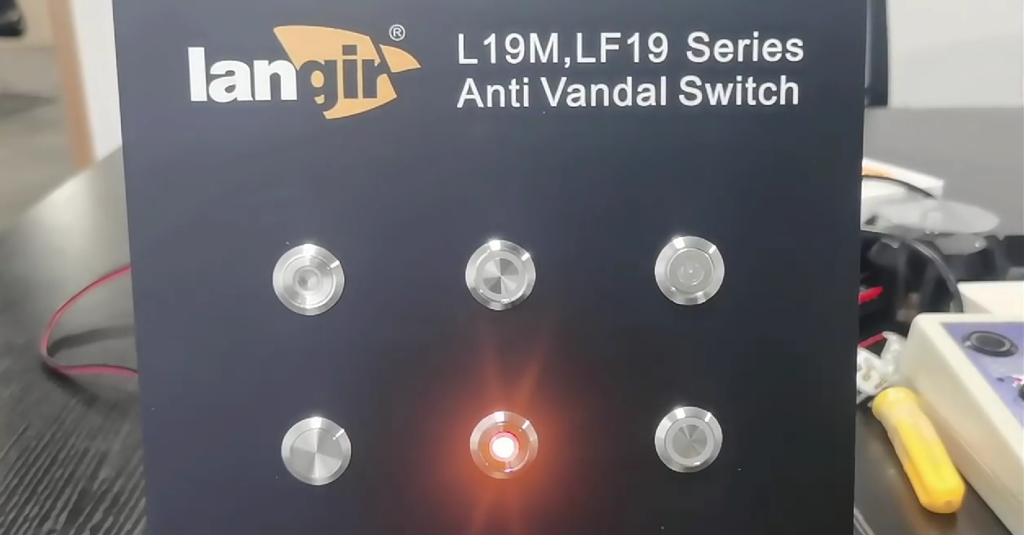
Get a quote for custom automotive push button switches from Langir
Customization Options for Automotive Push Button Switches
Custom options include actuator geometry, LED color, engraving detail, connector type, and electrical ratings—ensuring your switch integrates seamlessly into any vehicle architecture. This level of choice leads directly into Langir’s dedicated process for automotive clients.
Langir’s Custom Manufacturing Process for Automotive Needs
Langir’s process begins with a design consultation to align on function, environment, and aesthetics. Prototyping uses rapid-turn tooling for real-world validation, followed by comprehensive environmental and lifecycle testing. Volume production then scales your custom design with consistent quality and traceability.
By combining in-house engineering, ISO-certified production, and fast turnaround, Langir delivers switches that meet rigorous automotive standards and market demands.
Benefits of Bulk Ordering Customized Automotive Switches
Bulk orders bring economies of scale, predictable lead times, and dedicated support:
- Lower per-unit cost through volume discounts
- Guaranteed stock levels for production planning
- Single-point sourcing for multiple switch variants
Bulk supply reliability rounds out our look at customization before diving into technical specifications.
Key Features and Specifications of Automotive Push Button Switches
Automotive push button switches vary across voltage, current rating, sealing, materials, and tactile feel. Selecting the right specs ensures both safety and performance in your vehicle system.
Consider these critical attributes:
These specs guide engineering teams toward reliable component selection. Next, we’ll explore the trends shaping future switch applications.
Common Voltage and Current Ratings for Automotive Push Button Switches
Most automotive switches operate at 12 V systems with contact ratings from 1 A for signal-level switches up to 10 A for direct lighting or motor control. Higher-voltage 24 V and 36 V ratings serve heavy-duty vehicles and auxiliary systems.
Ensuring Durability in Automotive Switches with IP Ratings Like IP67
An IP67 rating guarantees total dust ingress protection and immersion up to 1 m for 30 minutes. This sealing is achieved through nitrile or silicone gaskets and overmolded housings—critical for off-road, marine, and under-bonnet applications.
Typical Materials and Mechanical Lifespan for Automotive Push Button Switches
Corrosion-resistant stainless steel and copper-nickel alloys form the contact surfaces, while ABS or polycarbonate housings withstand temperature extremes. Mechanical life spans range from 50,000 actuations in economy switches to over 1 million cycles in premium designs.
Improving User Experience in Vehicle Switches with Tactile Feedback
A crisp click and consistent actuation force deliver positive confirmation that the circuit has changed state. This haptic feedback reduces driver distraction and builds confidence in control inputs—closing the loop on specification considerations.
Emerging Trends and Future Outlooks for Automotive Push Button Switch Applications
The automotive industry is evolving with EVs, advanced infotainment, and smart interiors—driving innovation in switch design. Push button switches are adapting with haptic feedback, miniaturization, and eco-friendly materials.
Key emerging trends include:
- Electric/Hybrid Vehicle Integration – Multi-function switches linked to drive modes and battery management.
- Haptic Feedback Technology – Actuators providing programmable vibration patterns for adaptive controls.
- Sustainable Materials – Bioplastic housings and lead-free contacts to meet environmental regulations.
- Ultra-Miniaturization – Sub-20 mm form factors for slimline dash panels and wearable interfaces.
These advances point toward a future where switches blend mechanical reliability with digital intelligence—and set the stage for addressing common questions around automotive push button switches.
Impact of Electric and Hybrid Vehicles on Push Button Switch Use
EVs often replace ignition switches with drive-mode buttons that interface directly with electronic controllers, requiring switches rated for high-speed data signals and low-power standby modes.
Role of Haptic Feedback in Next-Generation Automotive Switches
Integrated haptic actuators simulate mechanical clicks or dynamic vibrations, giving drivers adaptive confirmation when controls shift between drive modes, infotainment selections, or advanced driver assistance features.
Influence of Miniaturization and Sustainability on Automotive Switch Design
Smaller switch footprints allow cleaner interiors, while recycled plastics and RoHS-compliant metals reduce environmental impact—meeting OEM demands for lighter, greener components.
Automotive Push Button Switch Applications | FAQs
Drivers and engineers often wonder how push button switches handle specific challenges without sifting through technical manuals. Here are the top inquiries with concise insights:
- Choosing the Right Start Button: Engineers select switches with built-in transponder recognition and LED rings for intuitive engine ignition.
- Waterproofing for Marine and Off-Road Use: IP67-rated buttons prevent water and dust ingress, ensuring reliable operation under harsh conditions.
- Custom Fit for Unique Dash Layouts: OEMs request bespoke actuator shapes, symbols, and illumination colors to match vehicle branding.
- Selecting Switch Types by Function: Momentary switches suit transient commands like horn or signal lamps, while latching switches handle sustained functions like headlights.
These insights clarify typical concerns and transition naturally into how Langir delivers solutions tailored to those exact questions.
Langir’s Support for Automotive Push Button Switch Needs
Langir combines manufacturing expertise, ISO-certified quality, and full customization to serve OEMs and industrial clients with reliable bulk or tailored switch solutions.
Why Choose Langir for Automotive Push Button Switch Manufacturing?
With over a decade of experience, Langir specializes in high-performance switch production, offering rapid prototyping, on-site tooling, and in-house testing labs. Our commitment to consistency and traceability builds trust across every project.
Certifications and Quality Standards Followed by Langir
Langir adheres to CE, CCC, RoHS, and ISO 9001 standards, ensuring all push button switches undergo rigorous electrical, mechanical, and environmental testing before shipment.
Requesting Quotes for Bulk or Custom Automotive Switches
Ready to streamline your next vehicle project? Visit our Contact Us – Langir page to discuss volume requirements, customization options, and lead times. Our team will guide you through design consultation, prototyping, and volume production—delivering switches that exceed expectations.
Every modern vehicle deserves switches engineered for performance and reliability. From engine start to emergency alerts, push button switches shape the user experience at every turn. As automotive control systems evolve with electrification and intelligent interfaces, Langir stands ready to supply and customize the exact switches you need—on time, in bulk, and built to last.
 EN
EN  FR
FR  PL
PL  PT
PT  ES
ES  JA
JA  RU
RU  AR
AR  IT
IT  NL
NL  TR
TR  KO
KO  DE
DE